
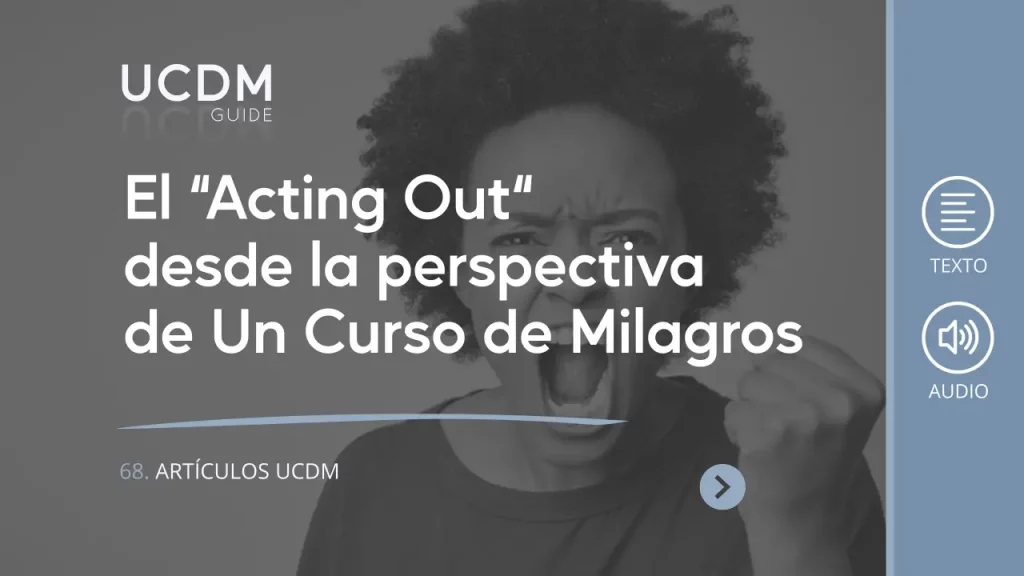
La proyección de la culpa inconsciente: Un análisis metafísico
The concept of "acting out" is well known in psychology and generally refers to the expression of unconscious thoughts or feelings through actions, often in an impulsive or destructive manner. Desde la perspectiva de Un Curso de Milagros (UCDM), este fenómeno adquiere un significado más profundo y se relaciona directamente con los principios fundamentales del Curso sobre la mente, la proyección y el perdón.
En este artículo, exploramos cómo lo entiende UCDM, sus raíces en la mente, sus manifestaciones en nuestras relaciones y comportamientos, y el camino que el Curso propone para sanar esta tendencia. A lo largo de nuestra discusión, veremos cómo se relaciona con conceptos clave como la proyección, la culpa, el miedo y el perdón.
The Root of "Acting Out" in the Mind
Para comprender el “acting out“ desde la perspectiva de UCDM, debemos comenzar por entender la visión del Curso sobre la estructura de la mente. Kenneth Wapnick, un destacado maestro del Curso, explica que nuestra mente tiene diferentes niveles: la Righteous mind, which reminds us of our true identity as Children of God; the wrong mind, who believes in separation and reality from the physical world; and the Decision Maker, who chooses between the right mind and the wrong mind.
From this perspective, it can be understood as a manifestation of the wrong mind's choice. When we choose to identify with the ego (the wrong mind), we experience guilt and fear, which we then project onto the outside world.
The Course teaches that projection makes perception. This means that first We choose to see guilt within ourselves, and then we project it outward, perceiving it in others and in the world. "Acting out" is a form of this projection, where our unresolved internal thoughts and feelings manifest in external behaviors.
El "acting out" refiere a la expresión de pensamientos o sentimientos inconscientes a través de acciones, a menudo de manera impulsiva o destructiva.
Guilt and fear, the driving force behind "Acting Out" as a defense mechanism
At the heart of "acting out" is the unconscious guilt that the Course identifies as the root of all our problems. Guilt gives way to the fear of punishment, so God is seen as an avenger who seeks to punish His children for their crime. The God of Love is thus transformed into a god of fear, and the peace that is our natural inheritance becomes a state of terror, anxiety, and continuous surveillance so that we may not be destroyed by the Father we think we have attacked.
This dynamic of guilt and fear creates a vicious cycle that drives it. We feel guilty about our apparent separation from God, fear punishment, and then project that guilt and fear onto the outside world through our actions and relationships.
Acting Out Manifestations
It can manifest itself in many ways in our lives. Some common ways include:
- Anger and aggression: The Course sees anger as a projection of our inner guilt. Anger always involves the projection of separation, which should ultimately be accepted as one's own responsibility, rather than blaming others.
- Addictions: Addictions can be seen as attempts to escape guilt and guilt. Internal fears. The Course suggests that these self-destructive behaviors are symbols of our ego choice.
- Special relationships: UCDM ve las relaciones “especiales“ como intentos de proyectar nuestra culpa en los demás. Buscamos en otros lo que creemos que nos falta, perpetuando así el ciclo de separación y culpa.
- Compulsive search for pleasure or success: Obsessive preoccupation with sex, money, or success can be a form of "acting out" that seeks to fill an internal void.
The role of denial and repression
It's important to understand that "acting out" often occurs when we deny or repress our thoughts and feelings. The Course does not advocate repression, but neither does it advocate uncontrolled expression. From the ego's point of view, the situation could not have worked more in his favor because, given the two alternatives—repression or expression—he cannot lose.

Either way, anger has become the problem that needs to be solved, and the real problem —The underlying guilt— it effectively hides behind the smokescreen of the ego.
The Course proposes a third way: to recognize our thoughts and feelings without judging them, and to bring them into the light of forgiveness.
The Path of the Course to Healing
UCDM ofrece un enfoque único para sanar la tendencia al “acting out“. Este enfoque se basa en varios principios clave:
- Recognition: The first step is to recognize that it is a projection of our inner guilt. The Course reminds us that we are never upset for the reason we believe. This recognition allows us to begin to see that the problem is not "out there" but in our own minds.
- Responsibility: The Course invites us to take responsibility for our perceptions and choices. It is not about blaming ourselves, but about recognizing our power to choose again.
- Sorry: El perdón, tal como lo enseña UCDM, es la clave para sanarlo. El perdón reconoce que lo que pensamos que nuestro hermano nos había hecho en realidad nunca ocurrió. Al perdonar, reconocemos que lo que vemos en los demás es una proyección de nuestra propia culpa.
- Choosing a New Teacher: The Course invites us to choose the Holy Spirit or Jesus as our inner teacher, rather than the ego. This choice allows us to see through the eyes of love rather than the eyes of fear and guilt.
- Stillness practice: UCDM enfatiza la importancia de la práctica diaria de la quietud y la meditación. Estos momentos nos permiten conectar con nuestra mente recta y escuchar la voz del Espíritu Santo.
The Role of the Mind in Healing
A crucial aspect of the Course's teaching is that healing occurs in the mind, not in behavior. We must change our minds, not our behavior. Correction belongs only to the level where change is possible. The changes mean nothing at the level of symptoms, where they cannot function.
This doesn't mean we shouldn't make changes in our behavior, especially if we're causing harm to ourselves or others. However, the Course emphasizes that true change must occur at the level of the mind to be lasting and meaningful.
The importance of patience and gentleness
It is important to remember that the process of healing acting out is gradual and requires patience and gentleness with oneself. The Course constantly reminds us not to judge ourselves for our mistakes, but to see them as opportunities for forgiveness and learning.
When we remember that We have chosen what we are experiencing, the chains that seemingly tied us to the screen, and ultimately to the observation chair itself, disappear and we are free.
We must change our minds, not our behavior.
"Acting Out" as a learning opportunity
From the perspective of the Course, even our "acting out" moments can be seen as opportunities for learning and spiritual growth. Whenever we find ourselves "acting out" our thoughts and feelings impulsively or destructively, we have the opportunity to:
- Observe our behavior without judging it.
- Acknowledge fault and underlying fears.
- Bring these thoughts and feelings to the Holy Spirit for healing.
- Practice forgiveness toward ourselves and others.
The relationship between "Acting Out" and special relationships
One area where it is particularly evident is in our special relationships. The Course teaches that we seek special relationships such as an attempt to complete ourselves, projecting our guilt and needs onto others.
The forgiveness of others is actually the forgiveness of ourselves, because it is our own fault that we see in them. We are not really forgiving other people for what they have thought or done; We are forgiving ourselves for what we have thought or done.
By recognizing this, we can begin to see our relationships as classrooms for forgiveness and healing, rather than battlegrounds for our fears and unmet needs.
We seek special relationships as an attempt to complete ourselves, projecting our guilt and needs onto others.
Acting Out and Cause and Effect Reversal
Importantly, it often involves a cause-and-effect reversal. We believe that our actions and behaviors are caused by external factors, when in fact they are the result of our internal choices.
The Course invites us to recognize that Ideas do not leave their source. This means that our thoughts and choices in the mind are the true cause of our experiences, not the other way around.
Recognizing this gives us enormous power, because it means that We can change our experience changing our thoughts and choices in the mind.
Our actions and behaviors are the result of our internal choices.
La práctica del “No hacer nada“
One of the most counterintuitive teachings of the Course in relation to "acting out" is the practice of "doing nothing". This does not mean being passive or indifferent, but recognizing that our frantic attempts to "do" or "fix" things are often forms of "acting out" of the ego.
We don't define a problem first and then say we have to do something about it. Rather we let the Holy Spirit guide us, allowing it to help us realize that the problem is not as we perceive it at all. Our only problem is to believe that we are separate.
This practice invites us to stop, breathe, and reconnect with our righteous mind before acting.
"Acting Out" and violence in society
It is interesting to consider how the concept relates to the violence and aggression we see in society. The violence we see in the media and in society is an expression of unconscious aspects of the ego that we are not willing to look at. In the past, many of people's emotions and feelings, both violent and sexual, for example, were kept really hidden and more repressed.
From this perspective, the violence we see in society can be understood as a Collective "acting out" of guilt and fear that we all share on an unconscious level.
Our frantic attempts to "do" or "fix" things are often forms of ego "acting out."
The healing of "Acting Out" on a social level
Although the Course focuses primarily on individual healing, its principles can also be applied on a societal level. The healing of "acting out" at the collective level would involve:
- Recognize our Shared responsibility by violence and aggression in society.
- Practice Collective forgiveness, recognizing that what we see in the "others" is a projection of our own collective guilt.
- Elect leaders and policies that reflect the Principles of Love and forgiveness instead of fear and attack.
- Encourage education and practices that promote inner peace and connection with our true nature.
Beyond the "Acting Out"
The path that A Course in Miracles proposes to heal him is a journey of self-discovery and transformation. It invites us to look beyond our superficial behaviors to discover the underlying beliefs and choices that drive them.
As we learn to recognize our "acting out" as a projection of our inner guilt and fear, We gain the ability to choose again. Every moment of expressing it becomes an opportunity to practice forgiveness and choose love over fear.
The Course reminds us that the salvation of the world depends on us. This is not a burden, but an acknowledgment of our inherent power to change our experience and, by extension, that of the world.
As we heal this tendency, we become living examples of peace and love in the world. Our relationships are transformed from battlefields into classrooms of forgiveness. And little by little, step by step, we contribute to the healing of the whole world.
The road is not always easy. Requires constant vigilance, willingness to look honestly at our thoughts and behaviors, and the willingness to choose love over and over again. But as the Course reminds us, a small desire for goodwill is enough.
In the end, the journey beyond "acting out" is a journey back to our true Self, a Being that is beyond all guilt, fear and need for projection. It is a journey back to the love that we truly are.