
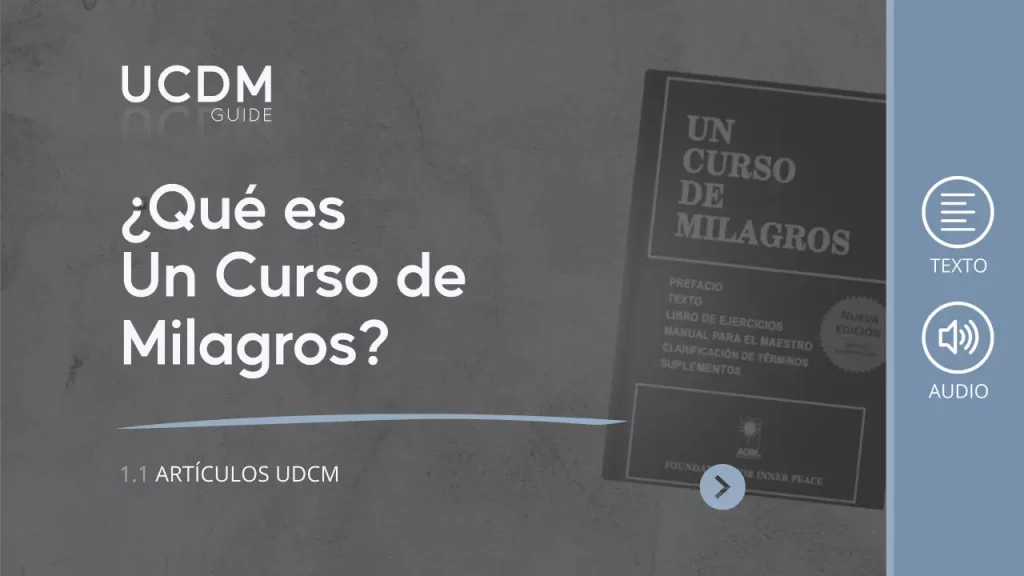
A Path to Inner Peace and Spiritual Transformation
Have you ever wondered if there is a way to find lasting peace in the midst of life's chaos? Have you felt that there is something beyond what your eyes perceive, a deeper, more loving reality? What if I told you that there is a spiritual path that can radically transform your perception of the world and yourself, leading you to experience unconditional love and oneness with all that exists?
Un Curso de Milagros (UCDM) es precisamente eso: una guía espiritual que promete llevarte de regreso a tu verdadera naturaleza como hijo de Dios.
The origins of the Course
A Course in Miracles has a fascinating history that reflects its own teachings on the power of union and forgiveness. The Course was channeled by Helen Schucman, a psychologist and professor at Columbia University, between 1965 and 1972. Helen, who described herself as an "atheist Jewish psychologist," began to hear an inner voice she identified as Jesus. This voice dictated the content of the Course, which she transcribed with the help of her colleague William Thetford.
The most surprising thing about this story is that Helen and Bill, despite being colleagues, had a tense and conflicted relationship. However, one day they decided that "There had to be another way" of relating. This seemingly simple decision was the catalyst that started the channeling of the Course. According to the Course, the holy instant is the result of our determination to be holy. It is the answer to our desire and will for it to come.
Este origen del Curso ilustra perfectamente uno de sus principios fundamentales: el poder de la decisión de unirse con un propósito común puede desencadenar milagros.
The Structure of the Course
A Course in Miracles It consists of three main books:
- The Text: It presents the theory and fundamental concepts of the Course.
- The Workbook: It contains 365 lessons, one for each day of the year, designed to train your mind in the practical application of the principles of the Course.
- The Teacher's Manual: Answer common questions and clarify key terms.
This structure is not accidental. The Text provides the conceptual framework, the Workbook offers daily practice, and the Handbook serves as a reference guide. Together, they form a complete program of spiritual transformation.
Los principios fundamentales de UCDM
1. The illusion of the world and the reality of love
A Course in Miracles presents a radical vision of the world: Everything we perceive with our senses is an illusion, a dream from which we need to wake up. The only reality is God's love, from which we have seemingly separated. According to the Course, nothing real can be threatened, for nothing unreal exists, and therein lies the peace of God.

Esta perspectiva puede ser difícil de aceptar al principio. Piensa en ello como si estuvieras viendo una película. Mientras estás inmerso en ella, las emociones y situaciones parecen muy reales. Pero cuando termina y se encienden las luces, te das cuenta de que todo era una proyección en una pantalla. De manera similar, UCDM nos invita a “encender las luces“ y ver más allá de la ilusión del mundo físico.
Everything we perceive with our senses is an illusion, a dream from which we need to wake up.
2. The Ego and the Holy Spirit
The Course describes two "voices" in our minds: the ego and the Holy Spirit. The ego is the thought system based on fear, separation, and attack. The Holy Spirit represents the voice of love, unity, and forgiveness.
Imagine that your mind is like a radio that can tune into two stations: the ego station constantly broadcasts programs of fear, guilt, and judgment, while the Holy Spirit station emits messages of love, peace, and forgiveness. The Course teaches us to recognize these voices and to consciously choose which one we want to listen to.
3. Forgiveness as a path to peace
Forgiveness is the central concept of A Course in Miracles, but its definition is very different from what we normally understand. For the Course, forgiveness is not "overlooking" the sins of others, but Recognize that nothing has actually happened that needs forgiveness. According to the Course, forgiveness recognizes that what you thought your brother had done to you never actually happened.
This may sound strange at first, but think of it this way: if everything is an illusion, like a dream, then the "attacks" or "offenses" we perceive are just as real as the injuries suffered in a nighttime dream.
Al despertar, nos damos cuenta de que no necesitamos perdonar a nadie por lo que hizo en nuestro sueño. El perdón según UCDM es ese despertar, esa comprensión de que nada real ha ocurrido y que, por lo tanto, no hay nada que necesite ser perdonado.
La práctica de UCDM en la vida diaria
Applying Workbook Lessons
The Workbook is the primary tool for applying the principles of the Course in your daily life. Each lesson is designed to be practiced over one day. For example, Lesson 1 invites us to recognize that "nothing we see in this room, on this street, from this window, in this place, means anything."
This lesson may seem disconcerting or even disturbing at first. But its purpose is to begin to Questioning our habitual perceptions and open our minds to a new way of seeing. As we practice this and the following lessons, we gradually begin to let go of our attachment to the judgments and meanings we have given to the world.
As we practice the Workbook, we learn to look beyond appearances and recognize that nothing we perceive has inherent meaning. It is our own mind that has projected meanings and values onto the world. By letting go of these projections, we open ourselves up to seeing reality as it is, without the distortions of the ego.
Cultivating mindfulness
Un aspecto crucial de la práctica de UCDM es desarrollar la capacidad de observar nuestros pensamientos sin juzgarlos. Esto es similar a la práctica de la atención plena o mindfulness. El Curso nos anima a ser observadores de nuestra mente, notando cuándo estamos escuchando la voz del ego y eligiendo conscientemente escuchar al Espíritu Santo en su lugar.
A practical way to do this is to set "reminders" throughout the day. You can use alarms on your phone or associate certain everyday activities (like washing your hands or opening a door) with a moment of pause to observe your thoughts and choose peace.
Practicing forgiveness in relationships
Relationships are the perfect "laboratory" to practice the teachings of the Course. Every interaction, especially the difficult ones, is an opportunity to choose between ego and the Holy Spirit, between attack and forgiveness.
The next time you feel upset with someone, try this exercise:
- Recognize that you are upset and that you have chosen to listen to the ego.
- Remember that what you see in the other is a projection of your own mind.
- Ask the Holy Spirit for help to see the situation differently.
- He states: "I am willing to see this in a different way. I want the peace of God."
This process can transform even the most conflicted relationships into opportunities for healing and spiritual growth.
Every interaction, especially the difficult ones, is an opportunity to choose between ego and the Holy Spirit, between attack and forgiveness.
Los desafíos comunes al estudiar UCDM
Resistance and fear
It is common to experience resistance or fear when studying A Course in Miracles. His teachings are radical and deeply challenge our long-held beliefs about ourselves and the world. The Course itself recognizes that This course may seem difficult at first, and very surprising in some respects, because we have been told that our function is to be happy, but also that the world is a place of sadness, evil and despair.
It's important to be patient and kind to yourself during this process. Resistance is a natural part of learning and it doesn't mean you're doing something wrong. In fact, acknowledging and accepting your resistance can be an important step in your spiritual journey.
Conceptual confusion
UCDM utiliza un lenguaje y conceptos que pueden resultar confusos o abrumadores al principio. Términos como “ego”, “Espíritu Santo”, “milagros” y “Expiación” tienen significados específicos en el contexto del Curso que pueden diferir de sus usos comunes o religiosos tradicionales.
Don't worry if you don't understand everything right away. The Course is a gradual process of retraining the mind. With time and practice, the concepts will become clearer. The most important thing is practical application, not perfect intellectual understanding.
Integration with other beliefs and practices
Muchos estudiantes se preguntan cómo integrar UCDM con sus creencias religiosas o espirituales existentes. El Curso no exige que abandones otras prácticas, pero sí pide que estés dispuesto a cuestionar todas tus creencias. Según el Curso, este no es un curso de especulación filosófica, ni está interesado en una terminología precisa, pues su único propósito es la salvación.
Lo importante es mantener una mente abierta y estar dispuesto a ver las cosas de una manera nueva. UCDM puede complementar otras prácticas espirituales, siempre que estés dispuesto a examinar y posiblemente soltar las creencias que no están alineadas con sus principios fundamentales.
The Course does not seek to replace or invalidate other traditions, but rather to offer a different perspective that can enrich and deepen your spiritual journey. Their focus is on liberation from suffering through forgiveness and awakening to our true divine nature.
The journey to awakening
A Course in Miracles is not simply a book to read or a philosophy to study. It is a path of profound transformation that invites us to awaken to our true nature as children of God. Through study and practice, we can learn to see beyond the illusions of the world and experience the peace and love that are our heritage.
The journey can be challenging at times, but the Course assures us that we are not alone. The Holy Spirit is always with us, ready to guide us every step of the way. According to the Course, we must not forget that once this journey has begun, the end is certain. The doubts along the way will come and go, and then they will go never to return, for no one can stop doing what God has commanded them to do.
As you embark on this journey with A Course in Miracles, remember to be patient and kind to yourself. Every small step toward forgiveness and love is a miracle in itself. And with each miracle, you come closer to the peace of God that is your true home.
Frequently Asked Questions about A Course in Miracles
What is a Course in Miracles?
A Course in Miracles (UDCM) is a book that focuses on spiritual and psychological self-study. It provides a path to attain inner peace and unity consciousness through true forgiveness and mindset change.
What is the importance of knowing a Course in Miracles?
Knowing a Course in Miracles can help people find inner peace, understand how to apply unity consciousness in their lives, and experience a mindset shift toward love and compassion.
How is a Course in Miracles related to psychotherapy?
A Course in Miracles has been linked to psychotherapy because of its focus on mental and emotional healing, as well as transforming limiting beliefs. It can complement and enrich the therapeutic process.
Who is the Foundation for a Course in Miracles?
The Foundation for a Course in Miracles is the organization in charge of publishing and distributing the official version of UDCM, as well as promoting its study and application worldwide.
What is the transcript of a Course in Miracles?
UDCM's transcript refers to the original English text of the book, which has been translated into several languages so that more people can access his spiritual teachings.
What does the concept of duality mean in a Course in Miracles?
In UDCM, duality refers to the misperception of separation and conflict between people and the world. The course promotes unity consciousness to transcend this duality and experience inner peace.